Introduction to the used iPhone 15 Pro Max
The Used iPhone 15 Pro Max remains one of the strongest secondhand flagship buys in 2026 because the hardware is still genuinely premium: a 6.7-inch Super Retina XDR OLED display with ProMotion up to 120Hz, an A17 Pro chip, IP68 splash-, water-, and dust resistance, USB-C with USB 3 speeds up to 10Gb/s, and battery life designed for up to 29 hours of video playback. Apple also lists MagSafe wireless charging up to 15W and fast charging to 50% in around 30 minutes with a 20W adapter or higher.
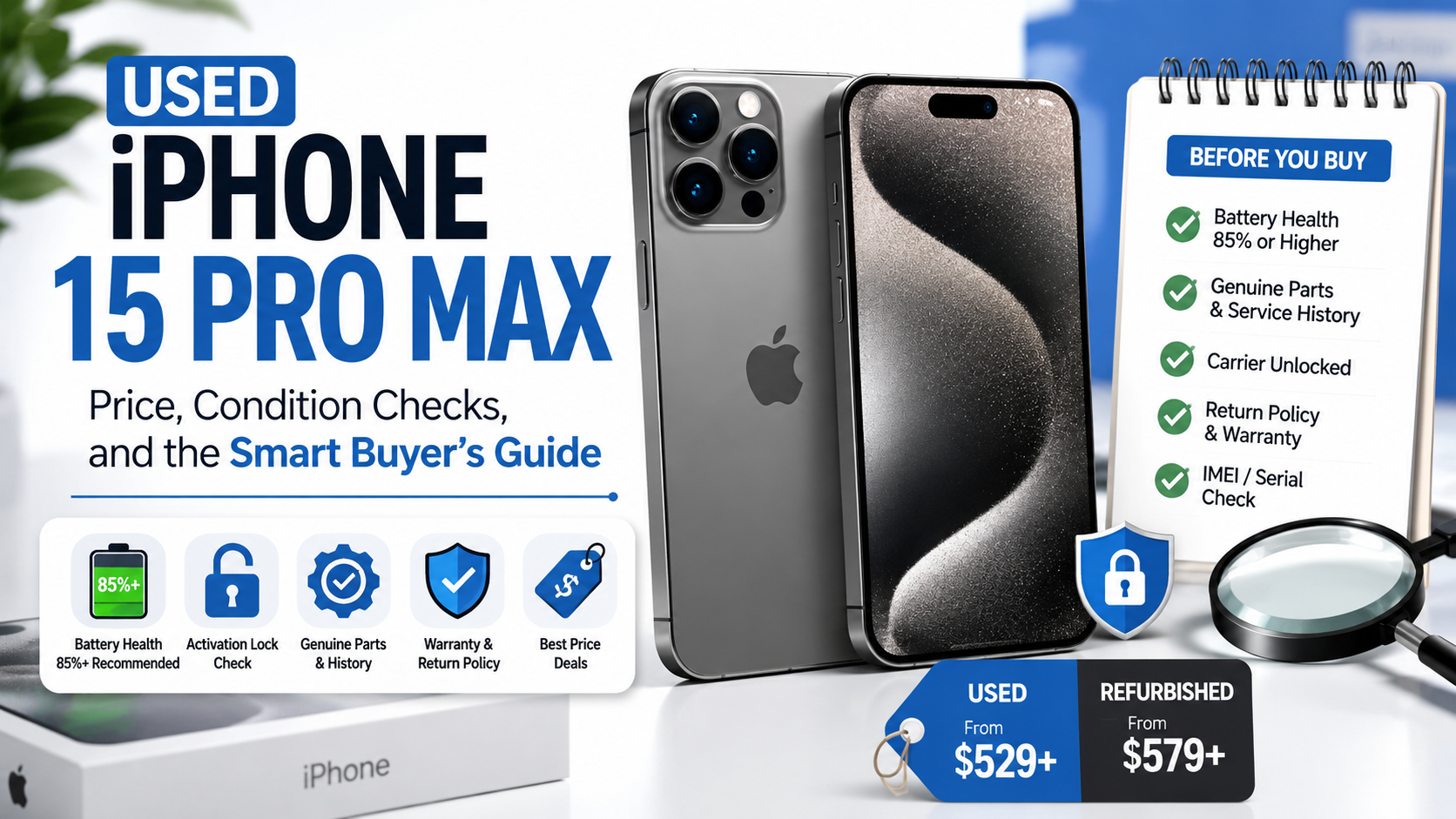
That is why demand for used and refurbished units stays strong. Live marketplace examples show a wide pricing spread: Swappie lists the iPhone 15 Pro Max from €589, Rebuy highlights 3-year warranty coverage and 21-day returns on its refurbished units, and eBay currently shows used/refurbished examples ranging from roughly the low $500s to the low $600s, depending on condition and seller.
But the best deal is not the cheapest one. The smart buy is the unit that passes the right checks: Activation Lock, battery health, repair history, display condition, and overall honesty of the listing. Apple specifically tells pre-owned buyers to inspect physical damage, battery health, parts, and service history, and to avoid any iPhone that is Activation Locked.
What is the real issue with a used iPhone 15 Pro Max?
The phone itself is excellent. The risk is everything around it.
A used iPhone 15 Pro Max can be a great purchase when the seller is honest and the device is properly checked. It becomes a bad purchase when a listing hides a weak battery, an unofficial repair, liquid damage, carrier restrictions, or a stolen-device lock. Apple’s own buying guidance makes the main risk clear: do not buy a pre-owned iPhone without checking condition, battery health, repair history, and Activation Lock status.
For most buyers, the goal is simple: get flagship performance without paying new-flagship money. The 15 Pro Max is still attractive because it has the A17 Pro chip, the 6.7-inch OLED ProMotion display, the 5x telephoto camera, and USB-C with USB 3 support. Those are not “old budget phone” specs; they are still high-end by today’s standards.
Why does this problem happen
The used-phone market is tricky because several issues are invisible at first glance:
- The seller may not know the battery’s real condition.
- A device may look clean but still have a non-genuine or previously used part.
- Activation Lock can make the phone unusable after purchase.
- Water resistance does not guarantee the phone will survive liquid exposure.
- A listing may say “excellent” while hiding frame bends, OLED burn-in, camera faults, or port wear.
- Refurbished, used, and open-box are not the same thing.
- Storage choice affects value more than many buyers expect.
Price snapshot: what a used iPhone 15 Pro Max costs
| Source | Example listing | What it suggests |
| Swappie | From €589 | Refurbished pricing can still be premium, but usually includes warranty and return protection. |
| rebuy | Refurbished units with 3-year warranty and 21-day returns | Strong buyer protection can justify slightly higher pricing. |
| eBay | Examples around $509.99, $557.99, $594.99, and $609.99 | Marketplace pricing moves fast and depends on condition, lock status, storage, and seller trust. |
A fair way to think about the market is this: used listings are cheapest but riskiest, refurbished listings are usually safer, and Trusted Refurb sellers often sit in the middle with warranty coverage. That is consistent with Apple’s advice to buy from reliable sellers and inspect the condition and return terms carefully.
How to buy a used iPhone 15 Pro Max safely
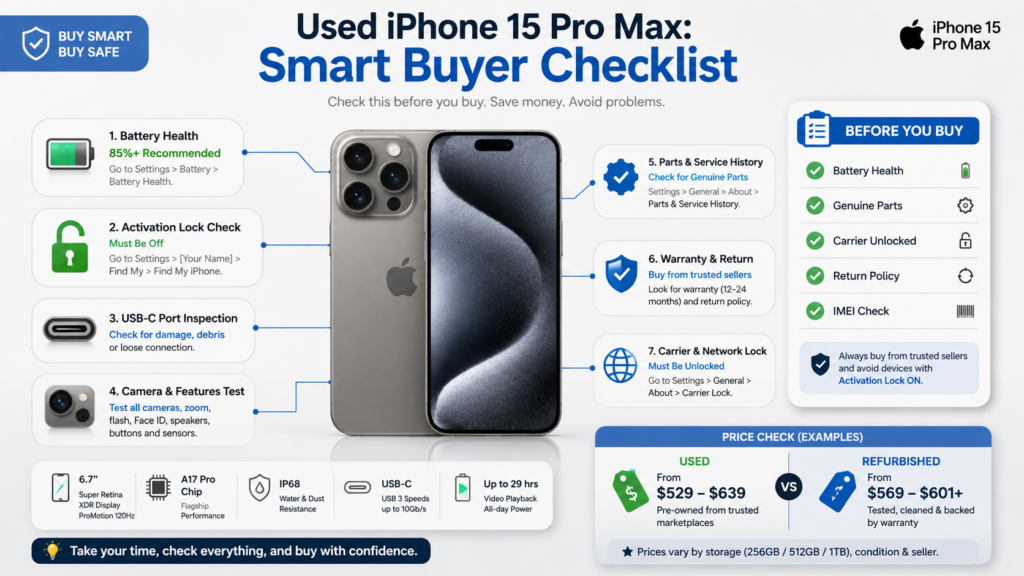
1) Check Activation Lock first
This is the most important step.
Apple says Find My includes Activation Lock, which is designed to prevent anyone else from using the device if it is lost or stolen. Apple’s guidance is blunt: do not buy an iPhone if Activation Lock is enabled. If you are with the seller and see the Locked to Owner screen, the seller must enter the Apple Account password to turn it off.
What to do
- Turn on the phone.
- Look for the setup screen, not the Locked to Owner screen.
- Ask the seller to remove the device from their Apple Account and erase it properly.
- Make sure the phone boots normally after a reset.
Green flag: the iPhone boots to the normal Hello/setup screen and can be activated without the seller’s Apple Account.
Red flag: any sign of owner lock, iCloud lock, or refusal to sign out.
2) Check battery health, not just battery percentage
A battery can show “good” and still age badly under real use. Apple explains that battery capacity depends on chemical age, charge cycles, and how the device was charged over time. For iPhone 15 models, Apple says the battery is designed to retain 80% of its original capacity at 1000 complete charge cycles under ideal conditions.
What to do
- Go to Settings > Battery > Battery Health & Charging.
- Check the maximum capacity.
- Ask for the cycle count if available.
- Prefer a seller who discloses battery health honestly.
Practical buying rule: for a used flagship, a clearly disclosed battery health reading is far better than a vague “battery fine” claim.
3) Review Parts and Service History
This is one of the biggest value checks many buyers miss.
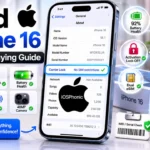
Apple says you can view Parts and Service History in Settings > General > About on iOS 15.2 and later. The section can show whether a repair used genuine Apple parts, and Apple also explains that parts can be labeled in ways that signal genuine, unknown, or previously used status. Apple’s newer parts support notes that these repair details help buyers understand the device’s history.
What to do
- Open Settings > General > About.
- Scroll to Parts and Service History.
- Confirm whether battery, display, camera, or logic board repairs were done.
- Prefer listings that are transparent about prior repairs.
Why it matters: A repaired phone is not automatically bad, but an unknown repair history can affect reliability, value, and future resale.
4) Inspect the display, frame, cameras, and USB-C port
The iPhone 15 Pro Max uses a 6.7-inch OLED display with ProMotion up to 120Hz, a titanium design, Ceramic Shield front, and a USB-C port with USB 3 support up to 10Gb/s. That means screen damage, port wear, and camera faults matter more than a small cosmetic scratch.
What to check
- Screen brightness and uniformity
- Dead pixels or OLED burn-in
- Touch response across the whole panel
- Titanium frame bends, dents, and corner damage
- Camera focus, stabilization, and lens clarity
- USB-C charging and data transfer
- Speaker and microphone quality
Simple test: open the camera app, switch between 0.5x, 1x, 2x, and 5x, and record a short video. Then plug in a known-good USB-C cable and confirm the phone charges normally.
5) Do not overtrust water resistance claims
Apple rates the iPhone 15 Pro Max as IP68 under IEC standard 60529, tested to a maximum depth of 6 meters for up to 30 minutes under controlled lab conditions. Apple also says splash, water, and dust resistance are not permanent and can weaken over time, and liquid damage is not covered by warranty.
That means a used phone can still have hidden moisture damage even if the seller says, “It works fine.” Ask questions, inspect carefully, and avoid any listing that suggests prior liquid exposure.
Used vs refurbished vs open-box
| Type | Typical risk | Buyer protection | Best for |
| Used | Highest | Most buyers want a safer secondhand purchase. | Buyers who can inspect in person and judge risk well. |
| Refurbished | Lower | Often includes warranty and returns | Most buyers who want a safer secondhand purchase. |
| Open-box | Medium | Varies by seller | Buyers who want near-new condition and can verify everything. |
Best choice for most people: a reputable refurbished listing with a clear warranty, return window, battery disclosure, and unlocked status. That aligns closely with Apple’s advice to buy from sellers with transparent inspection and return policies.
Which storage size is smartest?
Apple sold the iPhone 15 Pro Max in 256GB, 512GB, and 1TB capacities.
| Storage | Best for | Buying advice |
| 256GB | Most users | Best value for most people, especially if you stream media and use cloud storage. |
| 512GB | Heavy photo/video users | Better for 4K video, local files, and longer ownership. |
| 1TB | Power users | Only worth it if you truly need large local storage. |
Marketplace pricing usually rises as storage rises, so the best value is often the lowest capacity that comfortably fits your real usage. That is why 256GB is the safest value pick for most buyers.
The best buying checklist before you pay
Use this checklist before you send money:
- Confirm Activation Lock is off.
- Check battery health and ask about cycle count.
- Open Parts and Service History.
- Inspect the screen, frame, cameras, speakers, and USB-C port.
- Make sure the device is unlocked or compatible with your carrier.
- Check return policy, warranty length, and seller reputation.
- Prefer a listing that clearly states storage, condition grade, and exact accessories included.
Quick fix checklist for a buyer on the spot
If you have only two minutes, check these:
- Normal setup screen, not locked to the owner.
- Battery health is shown in Settings.
- No strange Parts and Service History warnings.
- The camera, speakers, and charging port all work.
- Return policy is written and clear.
Advanced checks for smarter buyers
Check if the phone is actually worth the upgrade
The iPhone 15 Pro Max still brings a lot to the table: A17 Pro performance, 5x telephoto camera, USB-C with USB 3, and strong battery life. Apple’s specs also show support for MagSafe up to 15W and fast charging to 50% in around 30 minutes with a 20W adapter or higher.
That makes it a stronger long-term buy than many older “used flagship” options, especially if you want a device that still feels fast and modern in 2026.
Compare seller types before buying
Trusted refurbishers usually offer the safest balance of price and protection. Swappie Highlights Warranty and return coverage on its refurbished listings, while Rebuy emphasizes tested electronics, warranty, and a defined return window. Marketplace sites like eBay can be cheaper, but the listing quality varies much more.
Pros and cons of buying a used iPhone 15 Pro Max
Pros
- Flagship A17 Pro performance.
- Excellent 6.7-inch ProMotion display.
- USB-C with USB 3 speeds.
- Strong battery life and fast charging.
- Better value than buying new.
Cons
- Battery wear is normal on used units.
- Repairs may have used unknown or non-genuine parts.
- Activation Lock can make a device unusable.
- Water resistance can weaken over time.
Common mistakes to avoid
- Buying before checking Activation Lock.
- Trusting “battery okay” without seeing battery health.
- Ignoring Parts and Service History.
- Choosing the cheapest listing without a return policy.
- Overpaying for 1TB of storage you will never use.
- Assuming a clean exterior means the phone is problem-free.
Pro tips and hidden tricks
- Ask the seller for a video showing the phone booting, charging, and opening the camera app.
- Prefer listings that show the exact battery health number.
- Check the model number and storage against the seller’s description.
- Test Face ID during the handoff.
- Look at the USB-C port with a light for dust, corrosion, or looseness.
- Use the return window as real protection, not just a marketing line.
- Save screenshots of the listing before payment.
FAQs
Yes. It still has flagship hardware, a strong display, a powerful chip, and modern charging and camera features.
Activation Lock. Apple says not to buy an iPhone if Activation Lock is enabled.
There is no single perfect number, but lower wear is always safer. Apple says iPhone 15 batteries are designed to retain 80% capacity at 1000 cycles under ideal conditions.
Usually, yes, because refurbished listings often include testing, warranty, and returns.
For most buyers, 256GB is the best value. 512GB is better for heavy video users, and 1TB is only worth it for true storage-heavy workflows. Apple sold the model in 256GB, 512GB, and 1TB options.
Conclusion
A used iPhone 15 Pro Max is still a very strong buy in 2026 because the hardware remains flagship-level: A17 Pro, 6.7-inch ProMotion OLED, USB-C with USB 3, IP68 resistance, and excellent battery support. The winning purchase is not the cheapest listing. It is the one that passes the real checks: Activation Lock, battery health, repair history, and honest condition reporting.