Introduction of Used iPhone 16
Picking up a secondhand iPhone 16 might make sense when you’re after today’s Apple experience at less than the new price. This model holds its ground even now, powered by the A18 chip plus built-in Apple Intelligence features. Its screen measures 6.1 inches across, uses OLED tech, and brings Dynamic Island into play. Connectivity shifts to USB-C – no more Lightning cable needed around here. Dust and water won’t easily faze it thanks to IP68 protection baked right in. Photography gets a boost through a high-end two-lens setup headlined by a 48MP Fusion main shooter. All of that adds staying power once resale time rolls around.
Here’s the thing: just because something has been owned before doesn’t mean it’s smart to grab it. Hidden inside a secondhand phone might be a worn-out battery, locked service, sneaky third-party pieces, or problems tied to who sold it. So instead of only asking how many dollars are needed, ask whether that used iPhone 16 will actually work without trouble later. What Apple says about refurbished models zeroes in on these exact red flags – spotting them turns advice into something you can really use.
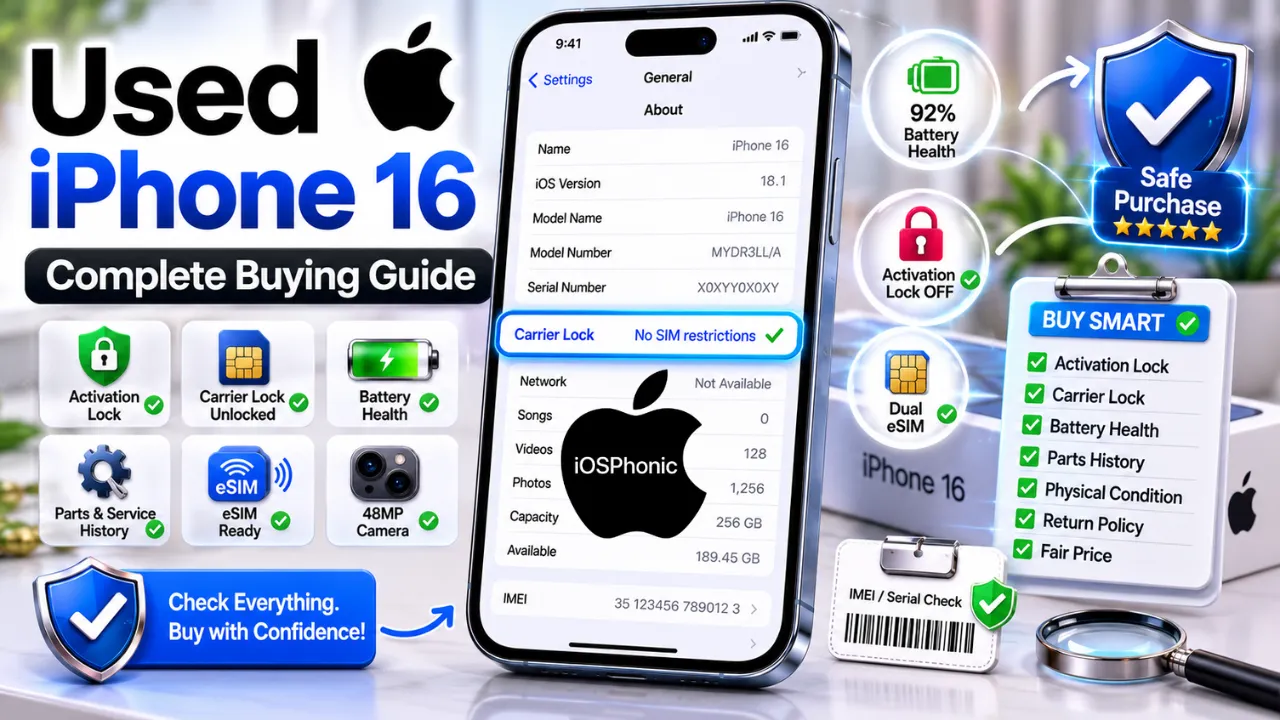
Start by looking at the Activation Lock status before anything else. While checking the phone, make sure the carrier lock is clear too. The battery health matters just as much as what repairs were done. A glance at service history reveals more than most think. Always know how returns work if something feels off later. Only then consider handing over any money.
What is the “used iPhone 16” issue?
This is not a troubleshooting problem in the usual sense. It is a buying-confidence problem.
People search this keyword because they want to know:
- Is the phone still worth buying?
- Is it unlocked?
- Is the battery healthy?
- Has it been repaired with genuine parts?
- Is the price fair?
- Is a refurbished safer than a used one?
So the article should do two things at once: explain value and explain risk. That is the exact gap between official Apple guidance, refurbished sales pages, and marketplace listings. Apple tells you what to inspect; the refurbished store shows the safer option; resale pages show value; and your article can connect all three.
Used iPhone 16 vs refurbished vs new
| Option | Best for | What you get | Main trade-off |
| New iPhone 16 | Buyers who want zero risk | Full retail device, untouched condition | Highest price |
| Apple refurbished iPhone 16 | Buyers who want the safest value | Lowest upfront cost if the condition is good | Stock can be limited |
| Used iPhone 16 | Buyers chasing the lowest price | Lowest upfront cost if condition is good | Highest inspection risk |
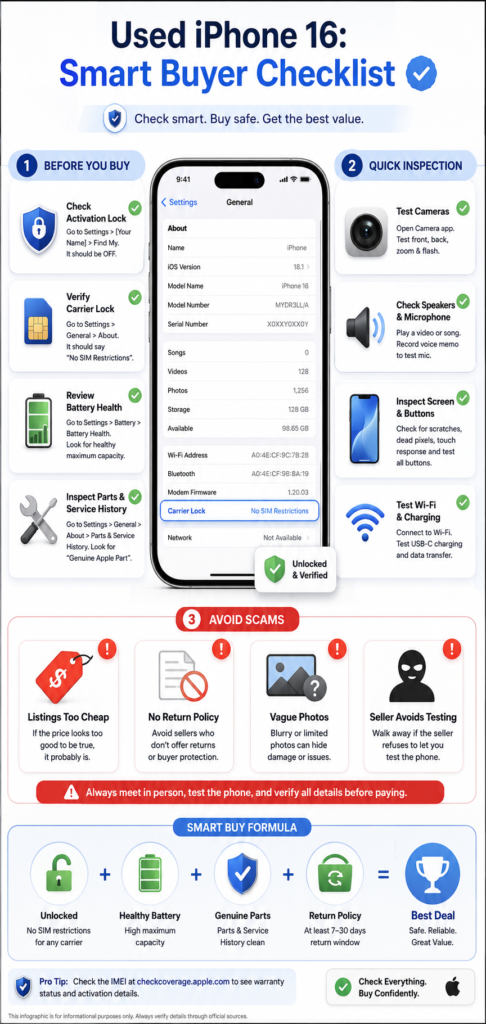
Apple’s refurbished program is the safest “used-like” option because it is thoroughly inspected and includes genuine Apple replacement parts as needed, plus the one-year warranty and new battery/outer shell. A private used phone can be a better bargain, but only if you verify its condition carefully.
Why does this problem happen
A used iPhone 16 becomes risky for a few predictable reasons:
- The seller hides battery wear or does not know the health of the battery. Apple says batteries are consumables and their capacity declines over time.
- The phone is Activation Locked, which means the buyer may not be able to use it properly.
- The phone is carrier locked, which limits network use. Apple says you can check whether “No SIM restrictions” appears in Settings > General > About.
- The device has had repairs and may show unknown parts or service history.
- The listing looks cheap but offers no return policy, no inspection, and vague photos. Apple specifically tells buyers to understand the return policy and inspect the device after purchase.
- Some buyers compare prices without matching model, storage, or condition correctly, which creates a false “deal.” The iPhone 16 comes in a 6.1-inch model and a 16 Plus model, with different sizes and capacities, so the exact variant matters.
How to buy a used iPhone 16 safely, step by step
1) Start with the seller, not the phone
A good deal begins with a trustworthy seller. Apple says to buy from a reliable seller and understand the return policy before you pay. That advice matters because a phone that looks fine on paper can still arrive with damage, lock issues, or hidden repair history.
Look for a seller who provides:
- Exact model name
- Storage size
- Clear photos
- Battery information
- Carrier status
- Return window
- Warranty or seller protection
If the listing is vague, treat it as a warning sign.
2) Check Activation Lock before money changes hands
Activation Lock is one of the most important checks because it helps prevent unauthorized use of the device. Apple says not to buy an iPhone that is Activation Locked. If you discover that after purchase, Apple says to return it.
What to ask the seller for:
A screenshot of the setup screen, proof that Find My is turned off, or a live video showing the device being signed out properly.
3) Confirm Carrier Lock or “No SIM restrictions.”
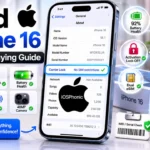
Apple’s current unlock guidance says to open Settings > General > About and check the line next to Carrier Lock. If “No SIM restrictions” appears, the iPhone is unlocked. Apple also documents the same check in its “Invalid SIM” help article.
This matters because a locked phone can be a headache if you use a different network or travel often. For a used iPhone 16, unlocked status usually adds real value.
4) Inspect Battery Health carefully
Apple says you can view battery health and maximum capacity in Settings, and it notes that batteries are consumables with a limited lifespan. In practical terms, that means a used iPhone 16 with a weak battery should be cheaper than one with strong battery health.
What good battery health means in a buying decision:
- Fewer charging problems
- Better daily battery life
- Lower chance of early replacement cost
- Stronger resale value later
Do not judge by percentage alone. Also, ask how the phone was used, whether it overheated, and whether the battery ever needed replacement.
5) Open Parts and Service History
This is one of the biggest trust checks on modern iPhones. Apple says that in Settings > General > About, you can see Parts and Service History if the iPhone has been repaired. Apple also says the history may show messages such as Genuine or Unknown, and that the parts history provides transparency about major part repairs.
Why this matters:
- Genuine parts are the safest sign.
- Unknown can mean the replacement was not verified as genuine.
- Poor repairs can affect safety, performance, and long-term reliability.
If a used iPhone 16 has a repaired display, battery, or camera, you want to know exactly what was replaced.
6) Test the physical condition in person
Apple’s pre-owned guide tells buyers to inspect the iPhone for physical damage and to make sure it is in the expected condition when it arrives. That means you should check more than the screen.
Test:
- Screen brightness and touch response
- Face ID
- Speakers
- Microphone
- Cameras
- Flash
- Buttons
- Charging port
- Wi-Fi and cellular signal
- Vibration
- ESIM setup or SIM support
For a used iPhone 16, the camera and display matter a lot because those are major value features in the lineup. Apple’s tech specs list the advanced dual-camera system, 48MP Fusion Main camera, and USB-C connector as core hardware points.
7) Verify the exact model
The iPhone 16 family is not one single device. Apple’s official tech specs show a 6.1-inch iPhone 16, a larger 16 Plus, and Pro variants with different display sizes and hardware. The standard iPhone 16 has the A18 chip, a 6.1-inch OLED display, Dynamic Island, and a USB-C connector.
This matters because a seller might advertise “iPhone 16” while sending a different storage size, a different model, or a condition that does not match the listing. Always confirm the exact model number and storage.
8) Check whether the device is right for your network
Apple’s iPhone 16 tech specs show dual eSIM support, and note that iPhone 16 and iPhone 16 Plus use advanced eSIM technology and are not compatible with physical SIM cards in those models. That makes carrier compatibility and network support important before purchase.
For a used buyer, the practical lesson is simple: do not assume the phone will work perfectly on your carrier just because it powers on.
9) Compare the asking price against the condition, not just the model name
A cheap used iPhone 16 is not automatically a bargain. A fair price depends on:
- Battery health
- Unlocked status
- Storage size
- Cosmetic condition
- Part history
- Warranty or return policy
- Region compatibility
A clean used iPhone 16 with strong battery health and unlocked status is worth much more than a damaged or locked unit, even if the model name is the same.
10) Only buy if the seller allows inspection and return
Apple’s pre-owned guidance is very clear: inspect the iPhone when you get it, and if it is not in the condition you expected, return it. That is the safety net that separates a smart used purchase from a risky one.
Quick buyer checklist
| Check | What you want to see | Why it matters |
| Activation Lock | Off / disabled | Prevents unusable devices |
| Carrier Lock | “No SIM restrictions” | Confirms unlocked status |
| Battery Health | Strong maximum capacity | Better battery life and value |
| Parts & Service History | Genuine parts or no issues | Improves trust and reliability |
| Physical condition | No cracks, dents, or display issues | Avoids hidden damage |
| Return policy | Clear and usable | Gives you protection after delivery |
This checklist mirrors the same risk areas Apple highlights for pre-owned buyers and repair transparency.
Best battery health, storage, and model to buy
For most buyers, the best used iPhone 16 is the one that balances battery health, clean history, and price. Apple’s Guidance does not give a universal “buy above this number” rule, but it does make clear that battery capacity declines over time and that battery condition affects how the phone performs.
Storage choice
- 128GB is fine for light users.
- 256GB is better for most people.
- 512GB makes sense for heavy photo, video, and app use.
Which model is best?
- Used iPhone 16: best balance for most buyers.
- Used iPhone 16 Plus: better battery and bigger display if you like large phones.
- Used iPhone 16 Pro / Pro Max: better if you want premium camera and display features, but usually at a higher price.
What most buyers should prioritize
- Unlocked status
- Battery health
- Genuine parts history
- Clean screen and body
- Return policy
Common scams to avoid
1) “Too cheap” listings
If the price is far below market for no obvious reason, assume there is a catch.
2) Vague photos
No close-ups of the screen, battery screen, carrier lock, or About page usually means the seller is hiding something.
3) No return policy
A used iPhone 16 without a return window is a much bigger risk.
4) Activation Lock excuses
Any seller who says, “I forgot my password,” is a hard pass. Apple says not to buy an Activation-Locked iPhone.
5) Unknown parts without explanation
A repaired device is not automatically bad, but unknown parts should reduce your trust and the price you are willing to pay. Apple’s parts history system exists so buyers can see repair transparency.
6) Carrier-locked phones sold as unlocked
Always verify the “No SIM restrictions” message yourself in Settings > General > About.
Comparison table: what matters most when buying used
| Feature | Why it matters on used iPhone 16 | Official check |
| A18 chip | Confirms it is the real iPhone 16 generation | Apple tech specs |
| 48MP Fusion Main camera | Strong camera value in the used market | Apple tech specs |
| USB-C | Faster, modern connector standard | Apple tech specs |
| Battery Health | Tells you how much usable life remains | Apple battery guidance |
| Carrier Lock | Determines network flexibility | Apple unlock guidance |
| Parts & Service History | Reveals repair transparency | Apple parts history guidance |
Pro tips and hidden tricks
- Ask for a live screen recording.
Have the seller open Settings > General > About and scroll slowly. That makes it harder to fake lock status, storage, or service history. - Check the model and storage before price negotiations.
A 128GB phone should not be priced like a 512GB phone. - Use the battery screen as a bargaining tool.
Apple says battery capacity declines over time, so a weaker battery should lower the price. - Prefer sellers with a return path.
Apple explicitly says to inspect the phone after delivery and return it if it is not as expected. - Treat “Unknown part” as a price cut, not a dealbreaker.
It is a signal to inspect more carefully and pay less. - Match the phone to your carrier and region.
Apple’s eSIM-based iPhone 16 design makes network compatibility especially important. - Use Apple refurbished as the benchmark.
Even if you buy used, Apple refurbished gives you a reference for safety, warranty, and condition.
Pros and cons of buying a used iPhone 16
| Pros | Cons |
| Lower price than new | Higher inspection risk |
| Modern chip and camera system | Battery wear may be present |
| Good long-term feature set | Possible lock or carrier issues |
| More value than older models | Repair history may be unknown |
The biggest advantage of a used iPhone 16 is that you can still get a very modern Apple experience at a lower cost. The biggest disadvantage is that you carry the risk Apple tells buyers to check for: lock status, battery health, damage, and repair history.
Privacy and data safety notes
One thing to check before handing over cash for a used iPhone 16 – did the seller sign out of their Apple ID? Without that step, problems start. Another key point: Find My must be switched off. Otherwise, the phone stays tied to the old account. Removal of Activation Lock matters just as much. It acts like a Gatekeeper, blocking access if left active. This setup helps stop thieves from using stolen devices. Both buyer and seller stay safer when these steps are done right. Protection kicks in fully only after those settings get cleared.
Should repairs happen, details on swapped components appear through Apple’s tracking tools. This visibility matters – security stays strong, speed holds up, confidence builds.
FAQs
Yes. Apple’s iPhone 16 still has the A18 chip, USB-C, Dynamic Island, 48MP Fusion Main camera, and Apple Intelligence support, so it remains a strong modern option if the unit is clean and unlocked.
Open Settings > General > About. If “No SIM restrictions” appears next to Carrier Lock, the iPhone is unlocked. Apple documents this exact check in its unlock support page.
Apple says battery capacity declines over time, so the higher the better. There is no universal magic number in Apple’s buyer guidance, but weak battery health should lower the price.
Usually yes. Apple says refurbished iPhones include a one-year warranty, a new battery, and a new outer shell, which makes them the safest used-like option.
Buying without checking Activation Lock, carrier lock, battery health, and parts history. Those are the four checks that most often decide whether the deal is safe.
Conclusion
Most people overlook what truly matters when picking up a secondhand iPhone 16. Spotting the cheapest tag won’t save you if the battery Barely Holds a charge. Instead, think about whether it’s unlocked – network freedom makes a difference later on. Original components matter more than glossy photos suggest. A scratch here or there? Fine, so long as nothing hides deeper issues. Return terms often reveal how much trust a seller expects you to have. Oddly enough, Apple quietly recommends checking every one of these things. Balance beats bargain hunting every single time.