Introduction
Getting a secondhand iPhone can feel like luck – until it turns into trouble. Some find out after paying that their phone connects to just one carrier, despite being called free to use anywhere. Switching service providers or heading abroad brings up the same doubt: Does this device actually work on any network? Many face that moment, wondering what went wrong.
It makes sense why folks get mixed up. Paying off your phone doesn’t mean it’s unlocked – some just assume it does. A lot believe what they see online, even when details aren’t verified. Turns out, trusting either of those ideas might cost more than expected.
Surprise – right inside your iPhone, Apple tucked a quick method to peek at carrier details. A tap here reveals what networks are running things now.
Start here if you want to check your iPhone’s Lock status. One way is through the phone’s built-in settings menu. Try inserting a different provider’s SIM card instead. Contacting the network operator works too. Another route uses the device’s IMEI number lookup. Smart shoppers watch out for sketchy deals. Mistakes happen most when skipping checks. Some tricks stay unnoticed until activation fails. Problems pop up even with factory resets. Real fixes come from hands-on trials, not manuals.
Once finished, you will clearly see if your iPhone has restrictions – no surprises later.
Featured Snippet Answer
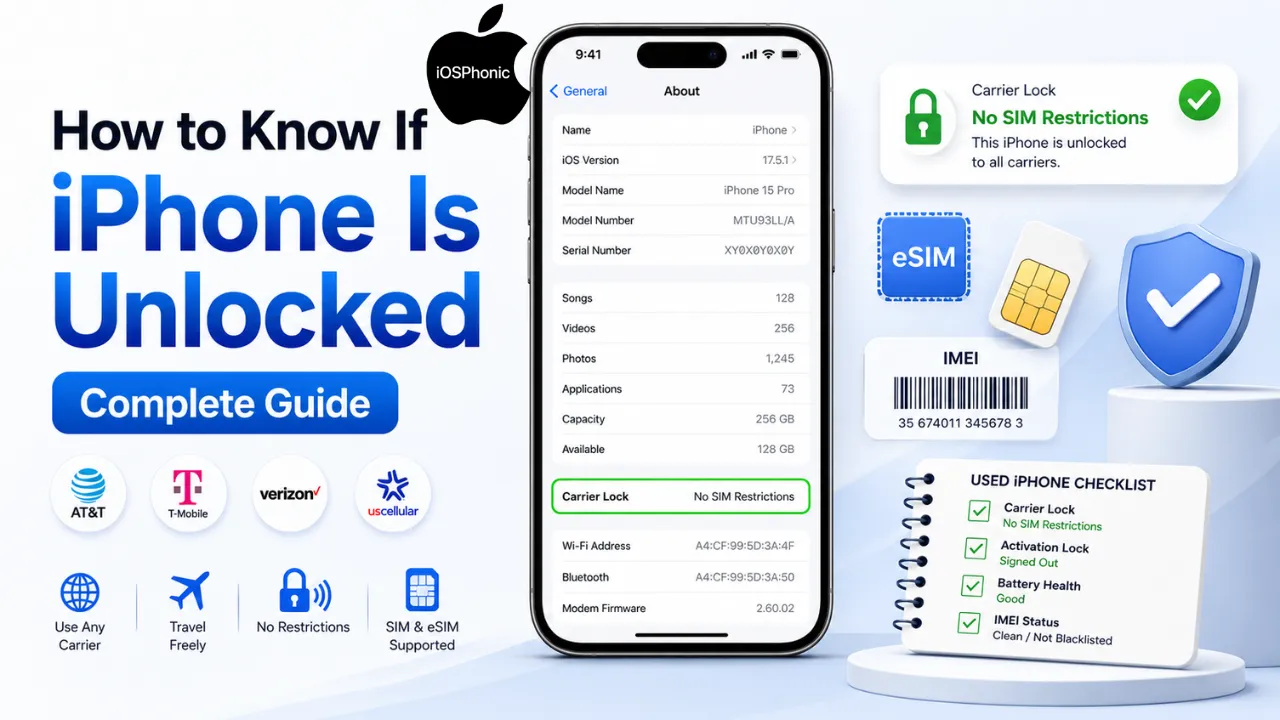
To know if your iPhone is unlocked, go to:
Settings → General → About → Carrier Lock
If it says:
No SIM Restrictions
Your iPhone is unlocked and can work with different compatible carriers.
If it says: If If
SIM Locked or shows a carrier name, the device is restricted.
What Is an Unlocked iPhone?
An unlocked iPhone is not tied to one mobile carrier.
This means you can:
- Switch networks anytime
- Insert SIM cards from other providers
- Use international SIM cards
- Avoid expensive roaming fees
- Activate eSIM services
- Sell your phone more easily
A locked iPhone only works with the original carrier until officially unlocked.
For example:
If a carrier sold your device with financing or contract terms, the phone may remain locked until the conditions are completed.
Why People Search “How to Know if iPhone Is Unlocked.”
Users typically search this when:
- Buying used iPhones
- Selling devices
- Changing carriers
- Traveling internationally
- Activating eSIM
- Using dual SIM
- Troubleshooting SIM issues
Checking takes less than two minutes and prevents major frustration later.
Why does this problem happen
Several reasons create confusion around iPhone unlock status:
Common causes:
- Carrier installment plans
- Devices purchased under contracts
- Seller misinformation
- Assumption that paid off means unlocked
- Refurbished phones with unknown history
- Imported devices
- Activation restrictions
- Incomplete carrier unlock requests
Many users never verify until the phone stops working with another SIM.
iPhone Locked vs Unlocked: Quick Comparison
| Feature | Locked iPhone | Unlocked iPhone |
| Works with one carrier | Yes | No |
| Switch providers freely | No | Yes |
| Better for travel | No | Yes |
| Higher resale value | Limited | Yes |
| Supports international SIM | Limited | Yes |
| Carrier flexibility | Restricted | Full |
Unlocked devices provide much greater flexibility.
How to Know If iPhone Is Unlocked: 9 Real Methods That Actually Work
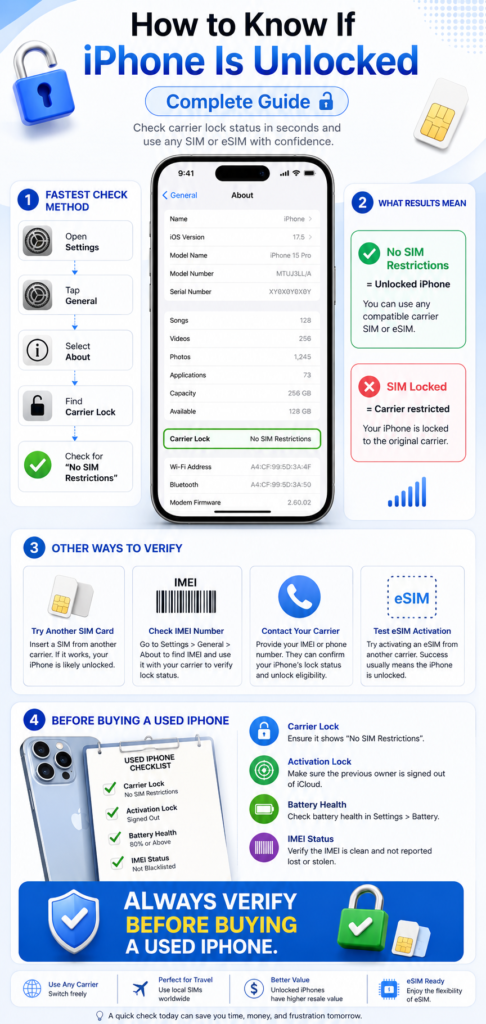
Fix 1: Check Carrier Lock in Settings (Best Method)
This is Apple’s easiest built-in method.
Steps:
- Open Settings
- Tap General
- Tap About
- Scroll down
- Find Carrier Lock
You’ll see one of two results:
No SIM Restrictions
Your iPhone is unlocked.
SIM Locked / Carrier Name
The device is restricted.
Use this fix when:
- You own the device
- Buying used phones locally
- Checking quickly
What Does “No SIM Restrictions” Mean?
Many users overthink this message.
It simply means:
Your iPhone is free from carrier restrictions.
You can:
✔ Insert different SIMs
✔ Use international carriers
✔ Activate eSIM
✔ Change plans freely
This is exactly what buyers want to see.
Fix 2: Test Another SIM Card
A physical SIM test provides extra confirmation.
Steps:
- Turn off the iPhone
- Remove the current SIM
- Insert another carrier SIM
- Power device on
- Wait for activation
If service works normally:
The iPhone is likely unlocked.
If you see:
- SIM Not Supported
- Invalid SIM
- Activation Required
The phone may still be locked.
Use this fix when:
The settings results seem unclear.
Fix 3: Contact Your Carrier
Sometimes direct verification is easiest.
Prepare:
- Phone number
- IMEI number
- Account details
Ask:
“Can you confirm if my iPhone is unlocked?”
The carrier can verify:
- Lock status
- Account restrictions
- Eligibility
- Pending requests
Use this fix when:
You bought the phone through carrier financing.
Fix 4: Check Using IMEI
Every iPhone includes a unique IMEI.
Find it here:
Settings → General → About → IMEI
Write the number down.
Carriers sometimes use IMEI databases to identify:
- Activation status
- Device eligibility
- Restrictions
Warning:
Many unofficial IMEI websites are inaccurate.
Prioritize:
- Settings method
- SIM testing
- Carrier verification
Fix 5: Check Before Buying Used iPhones
Used iPhone purchases create the biggest problems.
Ask sellers to open:
Settings → General → About
Then verify:
Carrier Lock → No SIM Restrictions
Never trust phrases like:
- Factory unlocked
- Works great
- Carrier free
Verify yourself.
Used iPhone Buying Checklist
| Check | Why It Matters |
| Carrier Lock | Avoid network restrictions |
| Activation Lock | Prevent ownership issues |
| Battery Health | Estimate lifespan |
| IMEI status | Avoid blacklisted devices |
| Physical condition | Identify hidden damage |
| Face ID | Confirm hardware function |
Fix 6: Check eSIM Compatibility
Modern iPhones increasingly rely on eSIM.
Successful activation from another provider may suggest the phone is unlocked.
However:
Always verify using Settings first.
This remains more reliable.
Fix 7: Watch During Setup
Setup screens sometimes reveal restrictions.
Signs include:
- Carrier branding
- Activation errors
- SIM warnings
- Restricted network messages
These often indicate carrier limitations.
Fix 8: Look for Seller Red Flags
Warning signs:
- Seller refuses Settings check
- Extremely low price
- Carrier financing history
- Incomplete answers
- Missing receipts
Multiple red flags deserve caution.
Fix 9: Check Apple Support Information
Apple explains carrier restrictions clearly through official documentation.
Official information confirms:
Carriers—not Apple—control unlock approval.
Many people incorrectly assume Apple unlocks devices directly.
Quick Fix Checklist
If you’re in a hurry:
Open Settings → General → About
Look for Carrier Lock
Verify “No SIM Restrictions“
Test another SIM
Check IMEI
Confirm with the carrier
Verify Activation Lock
Check battery health
Advanced Troubleshooting
If the status looks confusing:
Restart iPhone
Simple refreshes sometimes resolve activation confusion.
Steps:
- Turn off the device
- Wait 30 seconds
- Turn back on
Update iOS
Older software occasionally causes display issues.
Steps:
- Settings
- General
- Software Update
Install the latest version.
Reset Network Settings
Steps:
Settings → General → Transfer or Reset iPhone → Reset → Reset Network Settings
Use when:
SIM activation behaves abnormally.
Restore Through Finder
Last resort:
Backup first.
Restoring can refresh activation information.
Can Apple Unlock Your iPhone?
Short answer:
No.
Apple does not decide carrier restrictions.
Only original carriers can approve unlocking.
Once approved:
Apple updates activation databases.
Factory Unlocked vs Carrier Unlocked
People confuse these terms.
| Type | Meaning |
| Factory unlocked | Sold unlocked immediately |
| Carrier unlocked | Originally locked, later approved |
| Carrier locked | Restricted to one network |
Both unlocked versions work similarly.
Pros and Cons of Unlocked iPhones
Pros
- Freedom to switch carriers
- Better travel use
- Higher resale value
- Multiple network options
- eSIM flexibility
Cons
- Slightly higher upfront prices
- Limited financing promotions
Pro Tips & Hidden Expert Tricks
1. Check before meeting the seller
Request screenshots beforehand.
2. Test with your own SIM
Never rely only on screenshots.
3. Check blacklist status
Unlocked phones can still be blacklisted.
4. Use Wi-Fi during testing
Activation sometimes requires the internet.
5. Verify Activation Lock
Carrier unlock means nothing if Activation Lock remains enabled.
6. Ask for proof of purchase
Helps verify ownership.
7. Avoid rushed deals
Pressure often signals problems.
Common Mistakes to Avoid
Assuming paid-off means unlocked
Not always true.
Trusting online descriptions
Verify visually.
Using Random IMEI websites
Many are inaccurate.
Ignoring Activation Lock
This creates bigger issues than carrier locks.
Forgetting battery health
Hidden battery problems affect resale.
Privacy & Safety Notes
Before sharing:
- IMEI
- Serial number
- Screenshots
Only use trusted carriers or official support.
Never publicly post device identifiers.
Frequently Asked Questions
You can check directly in your iPhone settings:
Settings → General → About → Carrier Lock
If it says “No SIM Restrictions,” your iPhone is unlocked and can work with multiple compatible carriers.
No SIM Restrictions means your iPhone is not tied to one carrier. You can switch networks, use international SIM cards, and activate supported eSIM services without carrier limitations.
No. Paying off an iPhone does not always unlock it automatically. Some carriers require you to submit an unlock request even after completing payments.
In most cases, no. Carrier restrictions are controlled by your original mobile provider. You usually need approval from that carrier before the iPhone can be unlocked.
This message can appear because of:
Carrier restrictions
Unsupported SIM cards
Activation issues
Network compatibility problems
Contact your carrier if the issue continues.
Conclusion
Wondering whether your iPhone can switch carriers? Turns out it’s simpler than folks usually assume. Start by looking up the device status – this step cracks the code faster than anything else
Carrier Lock under About in General Settings
Should you spot “No SIM Restrictions,” that means the phone accepts any matching carrier. It runs on global SIMs along with digital ones, too. Compatibility opens up when those words show.
Most folks check their phone’s lock status when moving between carriers, heading overseas, handing off an old model, or Picking up a secondhand iPhone. A quick verification now skips headaches down the road. Done right, it takes under sixty seconds.
Start by testing the gadget in person before you commit – skip depending only on what sellers promise. One quick test now avoids big problems later.
Check out iosphonic.com if you want fixes for iPhone problems, tricks with iOS, or ways to use Apple gadgets better. Helpful stuff lives there, waiting without fanfare. Every guide fits someone stuck or curious. Click around when ready – no rush, just answers hiding in plain sight.